

Password Reset
Forgot your password? Enter the email address you used to create your account to initiate a password reset.


Forgot your password? Enter the email address you used to create your account to initiate a password reset.
3 Minutes
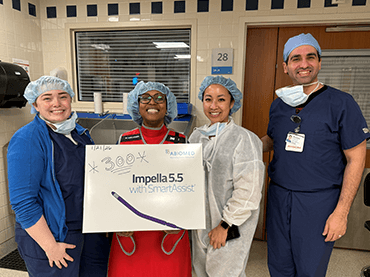 In January 2026, the Ventricular Assist (VAD) Device Program at UPMC achieved a significant clinical milestone, implanting the team’s 300th Impella 5.5® device, a minimally invasive pump intended for short term use for the treatment of ongoing cardiogenic shock occurring immediately following acute myocardial infarction or open heart surgery.
“We are proud to have impacted the lives of 300 patients with this device,” says Gavin Hickey, MD, medical director of the VAD Program and chair of the Cardiogenic Shock committee at UPMC. “This milestone is a testament to the team’s dedication to patient care and commitment to utilizing advanced technology and therapies to help patients with heart disease.”
“With our cardiogenic shock team, and this advanced technology, we have shown consistent improvement in survival and native heart recovery, says Nicole Kunz, RN, nurse lead for the UPMC System Wide Cardiogenic Shock Team. “Successfully managing cardiogenic shock cases is a team effort and could not be done without our interdisciplinary approach.”
In 2025, UPMC received a total of 303 cardiogenic shock calls. The use of Impella 5.5, combined with UPMC’s coordinated, education-driven model built and refined over multiple years to effectively respond to cardiogenic shock, has helped achieve a 76.5% patient survival rate.
“We are one of the few centers with consistent, 24/7 Impella 5.5 upgrade capability,” explains Dave Kaczorowski, MD, surgical director of the UPMC Heart Transplant Program and Mohamed Abdullah, MD, cardiac surgeon at the UPMC Heart and Vascular Institute. “Without the dedication of our surgical team and OR, CTICU, and CICU staff, this milestone and our excellent patient outcomes would not be possible.”
In 2025, the team at UPMC implanted a total of 87 Impella 5.5® pumps. As a temporary ventricular assist device, the Impella 5.5® reduces ventricular work and provides the circulatory support necessary for the patient’s heart to recover and for early assessment of residual myocardial function.
“Achieving this accomplishment requires full support and collaboration from a multidisciplinary team of experts,” says Dr. Hickey. “Our team brings together cardiologists, cardiac surgeons, clinicians and staff in the OR, CTICU, and CICU, APP’s, biomedical engineers, VAD coordinators, nurses, and physical, occupational, and respiratory therapists, and social workers, to design a treatment plan individualized to meet each patient’s needs.”
For more than 40 years, the VAD Program at UPMC has maintained a strong legacy of clinical excellence and innovation. From implanting the Jarvik Artificial Heart in 1985 to today's advanced circulatory support devices, the VAD Program at UPMC continually sets the standard in technological innovation and clinical excellence. Our program has served as a national training center for medical centers implementing certain VAD programs. To date, approximately 60 centers throughout the United States have sent teams of specialists to Pittsburgh for training exercises led by our artificial heart and VAD team.
The VAD Program at UPMC is an established leader in VAD technology, achieving groundbreaking milestones throughout the years.
To learn more, or refer a patient, email cttransplant@upmc.edu. For patient consults or transfer requests, call Medcall at 412-647-7000 and dial 1 for cardiogenic shock.

