

Password Reset
Forgot your password? Enter the email address you used to create your account to initiate a password reset.


Forgot your password? Enter the email address you used to create your account to initiate a password reset.
6 Minutes
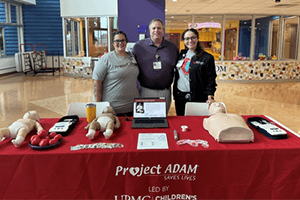 The Heart Institute at UPMC Children's Hospital of Pittsburgh became a Project ADAM affiliate in March 2024. The program's first community partner, the Irwin First Assembly church, earned its HeartSafe designation that September. A year and a half later, the work of the Project ADAM team at UPMC Children’s has expanded across western Pennsylvania, presented at regional and national meetings, is working to join a multi-institutional outcomes study, and has helped advance state legislation on AED access in schools.
The program is led by co-program coordinators Angela Keibler, BSN, RN, and Ashley Draxinger, MSN, RN, and medical director Bryan Funari, MD.
Project ADAM is a national organization that partners with children’s hospital entities to provide CPR and AED education for schools, communities, and youth sports. Project ADAM was established after the tragic death of Adam Lemel, a teenager from Wisconsin that collapsed during a basketball game and suffered a Sudden Cardiac Arrest. When his family learned that he could have been saved with the right preparation and equipment, they founded Project ADAM (Automated Defibrillators in Adams Memory) to be sure everyone is given the best possible chance to survive.
Geographically, the Project ADAM program at UPMC Children’s coordinates with the Children's Hospital of Philadelphia Project ADAM affiliate to provide coverage for the entire state of Pennsylvania. The two programs have divided Pennsylvania roughly in half, with UPMC Children's responsible for the western portion of the state – from Blair County westward.
The UPMC Children’s Project ADAM program now has more than 15 HeartSafe schools across its territory, with six new designations occuring just in March 2026. Most of that growth has come not from outbound recruitment but from word of mouth among school nurses, who serve as the primary point of contact at participating schools.
"School nurses talk to other school nurses, and once it starts in a district, it ripples down," Ms. Keibler says. "We get one school nurse within a district, and from there we're able to make more contacts. Right now, we are working closely with North Allegheny, North Hills, Pine Richland, and Fox Chapel school districts in the greater Pittsburgh region."
A presentation at the Pennsylvania Association of School Nurses and Practitioners conference at Penn State University helped accelerate that spread, generating interest that continues to make its way to the program team. Since the affiliation agreement was signed, more than 100 sites have contacted the program with questions about HeartSafe designation, AED purchasing, or general program guidance.
Schools are not the only entry point for the Project ADAM team. Patients seen at the Heart Institute at UPMC Children’s for conditions that increase their risk of sudden cardiac arrest, including various forms of congenital heart disease, cardiomyopathy, and inherited electrical disorders, are introduced to Project ADAM during their care, and families often carry news and advocacy of the program back to their own school communities.
"Talking to patients and families about Project ADAM while they are in the hospital is an important part of our educational process and helping create broader visibility about Project ADAM in our communities" Dr. Funari says. "But it’s more than that. It’s quite literally about saving lives – having the tools and education on site, on hand, should a cardiac emergency develop, be it with a student, teacher, staff, or visitor.”
Ms. Keibler and Ms. Draxinger delivered a continuing medical education webinar through UPMC Children's that drew participants from outside the region, and Dr. Funari has presented Project ADAM to UPMC Children's Community Pediatrics through a series of lunch-and-learn lectures and to colleagues through a Department of Anesthesia grand rounds.
In September 2025, Ms. Keibler and Ms. Draxinger represented UPMC Children's on a panel at the national Project ADAM meeting alongside other affiliates of less than three years' standing, sharing their lessons from the early phase of building the program at UPMC Children’s.
UPMC Children's is also moving toward participation in a multi-institutional Project ADAM-sponsored study examining long-term outcomes after pediatric sudden cardiac arrest.
"The study will look at what led to the sudden cardiac arrest, whether there was an underlying cardiac diagnosis or whether it was a traumatic event in an otherwise normal heart," Dr. Funari says. "It will also incorporate the time to initiation of CPR, AED arrival, and execution of proper care, and how those timing factors influence neurologic outcome and survival."
In early 2025, a designated HeartSafe school used its AED on a parent who became unresponsive in the school pickup line. A QR code linked to the device automatically alerted the program, prompting Ms. Keibler to follow up with the school's site coordinator and conduct a debrief of what happened and what the response was like.
"It wasn't the exact situation we prepare for, but the school had practiced, the staff knew where the AED was, and security at the school was able help in the process," Ms. Draxinger says. "It was a good outcome, and it showed that the broader preparation matters. The QR code feature worked the way it was designed to. This scenario is exactly why Project ADAM exists, why it matters, and why this kind of program needs to in every school – if not every public location.”
The Project ADAM program at UPMC Children’s is among the coalition members that have championed Pennsylvania Senate Bill 375, known as Greg Moyer's Law. The bill, sponsored by Sen. Rosemary Brown (PA-40), passed the Pennsylvania House on April 27 and will go back to the Senate for a concurrence vote before heading to the governor for signature. The legislation will require cardiac emergency response plans in schools, ensure CPR and automated external defibrillator (AED) trained staff are on-site in all buildings and at athletic events, and make AEDs accessible at school athletic events. The bill passed the Pennsylvania House on April 27.
Read a press release from the American Heart Association® about the Bill’s passing in which Dr. Funari contributed perspectives.
The program has so far operated on the volunteered hours of three clinicians. The next stage of growth will be a full-time coordinator position to expand the program’s work, allow for on-site designations at schools further away geographically from Pittsburgh, expand CPR education for inpatient and outpatient families of children at high risk for arrythmias or cardiac arrest, and more proactive outreach across the western half of Pennsylvania.
"Right now, we're doing this in our free time, and there's far more work than we can take on," Ms. Keibler says. "A full-time coordinator would let us do drills and designations across our territory the way the program needs."
For physicians whose patients or families may benefit from the program, or who want to learn more about Project ADAM at UPMC Children's, the team can be reached at chpprojectadam@upmc.edu, or please call 412-692-5540, option 7.

