

Password Reset
Forgot your password? Enter the email address you used to create your account to initiate a password reset.


Forgot your password? Enter the email address you used to create your account to initiate a password reset.
6 Minutes
Researchers at the UPMC Stroke Institute have developed and externally validated a web-based model designed to estimate an individual patient’s probability of achieving functional independence after endovascular therapy and after medical management alone. The Distal and Medium Vessel Occlusion Stroke (DUSK) Tool is currently available for research and educational purposes and requires prospective validation before clinical use.
The tool and the model that powers it are discussed in a recent study titled “Individualized Treatment in Distal and Medium Vessel Occlusion Stroke Using a Validated Explainable Counterfactual Treatment Estimation Model,” published in the May 2026 issue of Annals of Neurology.
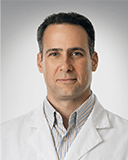
 Mohamed F. Doheim, MD, PhD, FRCP, clinical research assistant professor, Department of Neurology and director, NeuroPrecision Lab, was the study’s first author. Raul G. Nogueira, MD, FAHA, FSVIN, director of the UPMC Stroke Institute, was the senior author.
The study examines a treatment question that recent randomized trials have not been able to fully resolve, being the overall functional benefit from endovascular therapy for distal and medium vessel occlusion stroke. At the bedside, however, the most important question is whether the patient in front of a stroke team is likely to do better with thrombectomy than with medical management alone.
Using information collected during routine acute stroke evaluation, the DUSK Tool created by Dr. Doheim and colleagues estimates a patient’s probability of functional independence at 90 days under each treatment approach. The difference between those estimates is the potential treatment benefit for the patient.
“The main question clinicians are dealing with is which patients with distal and medium vessel occlusion stroke are likely to benefit from thrombectomy, by how much, and at what risk,” Dr. Doheim says. “The solution we offered in this paper was counterfactual estimation. We estimate what is likely to happen to the same patient at 90 days with thrombectomy and with medical management before treatment begins.”
Distal and medium vessel occlusions affect smaller cerebral arteries than the proximal large-vessel occlusions for which thrombectomy is established treatment. They account for a substantial share of acute ischemic strokes and often produce mild to moderate deficits. Those deficits, however, may be disabling when the occlusion affects language, vision, dexterity, or another eloquent function.
“I would not classify those effects as being mild, and I’m quite certain patients who experience them do not either,” Dr. Doheim says.
Treatment for these kinds of strokes, however, requires nuance and balance from clinical teams. Intravenous thrombolysis may work well against the smaller clot burden seen in these kinds of occlusions. Thrombectomy can reopen the vessel, but navigating smaller, more distal arteries can have greater procedural risk. Stroke severity, time to treatment, prestroke function, occlusion location, glucose, comorbidities, and other characteristics also often change the treatment options for individual patients.
The heterogeneity of distal and medium vessel occlusions helps to explain the limits of an average treatment effect. A neutral result across a clinical trial population of patients can include some who may benefit from thrombectomy, patients likely to do similarly with either strategy, or patients for whom the procedure may add risk without meaningful clinical benefit.
Dr. Doheim and colleagues developed the DUSK model using data from 321 adults treated at seven comprehensive stroke centers. Of those patients, 179 underwent endovascular therapy and 142 received medical management.
The model used clinical information available during routine stroke evaluation to estimate each patient’s probability of functional independence at 90 days under each treatment strategy. The investigators then tested the model in an independent group of 86 patients and compared its estimates with those produced by a separate causal machine-learning approach.
Across the full study population, adjusted analyses showed no statistically significant overall differences between endovascular therapy and medical management in favorable functional outcome, mortality, or symptomatic intracranial hemorrhage. About 90% of thrombectomy procedures successfully reopened the occluded vessel, but this technical success did not translate into better outcomes across the group.
“We are achieving technical success in 85% to 90% of thrombectomy cases, but functional independence as an outcome for patients remains below 50%,” Dr. Doheim says. “You can take the clot out and still not make the patient walk or talk again. That is the recanalization paradox.”
The study found no overall outcome advantage for thrombectomy when all 321 patients were analyzed together. But the results were different when stroke severity was considered. For patients with an NIHSS score of 8 or higher, thrombectomy was associated with three times the adjusted odds of achieving an mRS score of 0 or 1 at 90 days compared with medical management. That clinical benefit decreased as the time to treatment increased.
To evaluate DUSK using new patient data, Dr. Doheim and colleagues tested the model in an independent cohort of 86 patients. The model maintained similar discrimination for 90-day functional independence in that cohort, and its estimates of individual treatment benefit closely agreed with those generated by a separate causal machine-learning model.
The DUSK model created by Dr. Doheim and colleagues allows users to enter variables generally available during acute stroke evaluation, including age, NIHSS score, prestroke disability, glucose, occlusion territory, time from symptom onset, intravenous thrombolysis, and relevant comorbidities. It then returns the estimated probability of functional independence under thrombectomy and under medical management, the absolute difference between those probabilities, and a DUSK Clinical Score on a 20-point scale. “If the estimated probability of functional independence is 60% with thrombectomy and 53% with medical management, the seven-percentage-point difference becomes directly visible,” Dr. Doheim says. “In another scenario, medical management could be better. It depends on the characteristics entered into the model.”
By comparing the two probabilities, the DUSK model estimates if thrombectomy or medical management may produce the better outcome for that patient and the likely magnitude of the difference. This moves the treatment decision beyond applying an average trial result to every patient and helps distinguish those who may gain meaningfully from thrombectomy from those expected to do similarly, or better, with medical management.
“The goal is to move beyond predicting whether a patient will do well or poorly,” Dr. Doheim says. “We want to estimate how that patient’s outcome may change depending on the treatment they receive. That is the question DUSK is designed to examine at the level of the individual patient. The tool remains investigational and its estimates should complement, not replace, clinical judgment and shared decision-making.”
Doheim MF, Mohammaden MH, Abdelhamid H, et al. Individualized treatment in distal and medium vessel occlusion stroke using a validated explainable counterfactual treatment estimation model. Ann Neurol. 2026; 99: 1198-1209.

