

Password Reset
Forgot your password? Enter the email address you used to create your account to initiate a password reset.


Forgot your password? Enter the email address you used to create your account to initiate a password reset.
9 Minutes
This article is part of a larger series of articles on the UPMC Adult Spina Bifida Clinic. Visit the series main article for links to other article in the series.
The UPMC Adult Spina Bifida Clinic, one of the largest and oldest comprehensive, multidisciplinary care programs for adults living with the various forms of spina bifida, has developed and integrated a Peer Navigation Program as part of its formal clinical program infrastructure. The design, implementation, and evolution of the program are reflective of the clinic’s overall mission and a fundamental understanding that living with spina bifida involves challenges that extend well beyond medical management.
By creating a formal Peer Navigation Program for patients that leverages peer navigators who live with spina bifida, the program aims to provide training for peer mentors and mentorship, support, and perspectives for patients that largely fall outside the traditional clinical and health care domain. Patients benefit from interacting with professionals and community peers who understand their experiences firsthand, and who can provide insights, guidance, support, and community to those in need.
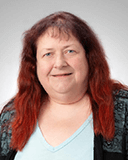
 The Peer Navigation Program (PNP) was designed and developed by coleaders Sara E. Izzo, BA, clinical research coordinator and peer counselor, and Monica Albert Still, BSN, RN, clinical nurse coordinator. Their work, and that of their clinic colleagues, has formalized the structure and direction of peer navigation in the UPMC Adult Spina Bifida Clinic. Their efforts, informed by their training and living their own lives with spina bifida, have created a dual model that includes one-on-one mentoring for patients and group-based support sessions with broad geographic reach.
In addition to Izzo and Still coleading the PNP, the program is cultivating a growing cohort of peer mentors from the adult spina bifida community who participate in one-on-one pairings with patients and in the group setting. This broader mentor pool ensures that patients can connect with others whose experiences and goals mirror their own.
“The PNP has two main components. One connects older adults with spina bifida to younger individuals so they can share lived experiences and set personal goals. The other is a group session format, where people can talk openly about what’s going on in their lives, be it work, school, or just the daily challenges they encounter while living with spina bifida. Our role is to support, not to direct,” Still says.
Izzo highlights how her life experience and career (her undergraduate training in psychology and her current pursuit of a master’s degree in counseling) positioned her to advocate for, and codevelop the program.

 Alongside Still and Izzo, the program includes Dan McCoy, MS, ACE-CPT, clinic personal trainer, and Cheyenne Hennen, BA, clinical research coordinator. Their complementary roles help broaden the reach of the PNP, ensuring patients can connect with peers across a range of experiences and support needs.
The PNP first emerged during the COVID-19 pandemic, when restrictions limited in-person care and many patients were struggling with isolation. Videoconferencing platforms provided a means to sustain engagement, and the clinic recognized the opportunity to create a structured model of peer-to-peer support that could expand the depth and reach of how the program interacts with, and cares for, patients with spina bifida.
The PNP initially was developed through the Spina Bifida Care Advisory Network of Western Pennsylvania, with early support from a grant awarded by the FISA Foundation. This foundational funding helped establish the training model and infrastructure needed to launch a sustainable program centered on peer support and lived experience.
Certification in peer support gave the program a defined framework, and alignment with Spina Bifida Association guidelines ensured that the services being offered reflected national standards of best practice. Izzo was certified as a peer supporter in 2017 and helped to formalize the certification process for the program in 2021.
“Certification gave us a structure to build from and ensured that what we were offering patients wasn’t just informal advice but a recognized and accountable form of support that had the backing of evidence-based practice and care guidelines,” Izzo says.
Peer navigators provide support in areas often not addressed by clinical staff or social work. They help patients prepare resumes, complete job applications, and develop strategies for financial planning that account for the complexities of government benefit programs. They also provide coaching in daily living skills and act as consistent points of contact during transitions or periods of crisis. These interactions fill gaps that otherwise go unaddressed in the formal health care system. This dedicated attention allows patients to build independence step by step.
“A lot of what I do is helping people figure out budgets, job applications, or just finding someone to understand their situation,” Izzo says. “These kinds of life skills and needs are not clinical in nature, but they can deeply impact one’s quality of life.”
The program also benefits from the involvement of Dan McCoy, who brings his lived experience as an adult with spina bifida to the PNP. In these settings, McCoy emphasizes the importance of listening as much as leading. Rather than focusing on his athletic achievements (McCoy is a Paralympic gold medalist and world champion in sled hockey), he approaches the groups as spaces where everyone learns together, and where small daily successes are celebrated alongside larger milestones.
“In the peer navigation groups, we’re all mentors and mentees at the same time. I try to be the last one to talk because I want to listen to others share their wins and struggles. We learn from each other. It’s not about who has done the most or achieved the most,” McCoy says.
Education about independence also extends into practical matters such as understanding how employment affects Medicaid eligibility or learning how to communicate effectively with clinicians.
“Part of what I do is teach patients about insurance, Medicaid, and how getting a job may affect your coverage. It also involves effective communication with medical providers and how to educate them about one’s condition. There is a lot of misunderstanding around the care needs of our patient population,” Still says.
The PNP, while aiding a sizeable population of adults with spina bifida in the UPMC region, also connects with many patients across the country through national virtual support groups. These support group sessions, currently held twice a month, allow adults with spina bifida from anywhere in the United States to join video sessions that bring together individuals from a wide range of regions on a regular basis. These meetings provide an outlet for sharing strategies, building community, and addressing topics from employment to adaptive recreation.
“It is important to emphasize that clinics like ours are rare in the United States, which means there’s a lot of unmet need out there,” Izzo says. “Our virtual sessions, which are open to anyone, anywhere, are a small step in providing some of the support, education, and encouragement that so many adults living with spina bifida don’t have regular access to.”
The group sessions provide reassurance and normalize experiences that can otherwise feel isolating.
“For many participants, these sessions are the first time they’ve been able to meet another adult with spina bifida. Building those connections has been one of the most meaningful outcomes of the program,” Hennen says.
Izzo adds that the group format reinforces the sense of community that patients need to thrive.
“The group sessions give people a space to talk openly, share strategies, and realize they’re not alone. That kind of connection can be just as important as anything we do in the clinic,” Izzo says.
While virtual sessions remain central to the program’s current operations, the PNP also is looking at expanding into in-person activities that promote independence and wellness. Plans include adaptive recreation events, workshops, and skill-building activities designed to address multiple dimensions of well-being.
These efforts will allow participants to practice daily living skills in real-world environments adapted to their needs, providing experiences that complement the virtual support already in place.
“We want to incorporate the eight dimensions of wellness – not just social connections, but physical activity, nutrition, and self-care,” Hennen says. “There’s a need for it, and I’m certain patients will embrace these kinds of services.”
Representation is at the heart of the PNP. By seeing adults with spina bifida working as part of the clinic team, patients gain visible proof of what is possible as an adult living with the condition. This presence not only reinforces trust in the program but also builds confidence that independence and meaningful participation in life are attainable goals.
“For me (and I know for my colleagues and so many of our patients) growing up, I didn’t know anybody with spina bifida,” Still says. “I didn’t have access to a lot of the knowledge and understanding of the condition that our clinic, and others like ours, are able to offer. How we’re structured as a clinic, how we operate, and what kinds of programs we are interested in developing reflect back on that. The PNP is one of those reflections.”
Peer navigators highlight self-advocacy by addressing patients directly during clinical transitions and encouraging them to engage as active participants in their care. Their leadership shows patients that they can both manage their health and pursue personal and professional goals.
“I was a participant in the peer program before I worked here, and now I’m part of the team. That shift helps patients see what is possible,” Hennen says.
The program also emphasizes reciprocity, as navigators often describe learning from patients themselves. This dynamic reinforces the idea that the clinic is a shared space for growth and empowerment.
“That’s what we’re aiming for — growth of the PNP to reach as many people as we can, locally and nationally,” Izzo says.

