Password Reset
Forgot your password? Enter the email address you used to create your account to initiate a password reset.


Forgot your password? Enter the email address you used to create your account to initiate a password reset.
11 Minutes
 Drew Redepenning, MD, is a third-year resident in the Department of Physical Medicine and Rehabilitation at the University of Pittsburgh School of Medicine. Dr. Redepenning’s clinical and research interests include spinal cord injury, assistive technology, and adaptive gaming technologies.
Below, Dr. Redepenning talks about how he became interested in adaptive gaming, how adaptive gaming fits within rehabilitation medicine, how patients can gain access to these systems, and why participation in digital environments carries meaningful social and functional implications for individuals who have physical limitations.
Q: How do you explain adaptive gaming to clinicians who may not be familiar with it?
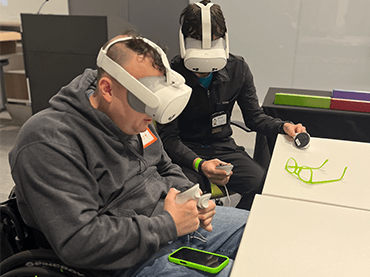
A: Adaptive gaming is the modification of video game systems so individuals with physical disabilities can participate in environments that were originally designed around standard hand-held controllers. That can involve specialized hardware, alternative input systems, switches, customized joysticks, and software configurations that translate limited physical movement into usable controls.
From a rehabilitation standpoint, it fits naturally within assistive technology, because it is assistive technology. We’re talking about video games, but it’s so much more than that for our patients, and also in terms of what clinicians should know about it. We already work to help individuals return to work, communicate more effectively, and manage daily activities through modified tools and interfaces. Gaming is a meaningful activity that people often want to return to after injury, particularly because it connects directly to social interaction.
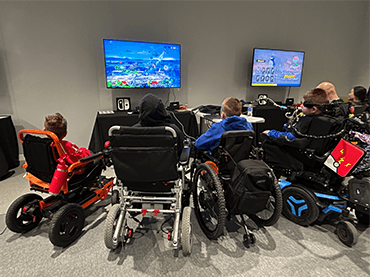
A lot of patients, especially younger individuals, use gaming platforms as primary social environments. It is where they spend time with friends, communicate, and maintain shared routines. When an injury or illness disrupts that access, it is not just a recreational loss. It can mean disconnection from an established social network. That has real, measurable, and profound clinical implications – physically and psychologically. Restoring that access allows people to reenter a familiar social setting rather than creating an entirely new one. It opens doors that were closed. More than you might expect.
Q: Your path into this work did not begin in medical school. What were you doing before you decided to become a doctor?
A: My background is in biomedical engineering – my undergraduate degree from the University of Minnesota was in that discipline. After college, but before medical school, I worked for several years as an assistive technology specialist in Minnesota. That role involved collaborating closely with individuals who had neurologic injuries, mobility limitations, and complex functional needs.
Most of the work focused on practical goals: helping people return to school or employment, improving access to communication systems, and configuring environmental control technologies so they could operate devices in their homes more independently. It was hands-on, problem-solving work that combined engineering with direct patient interaction. I love engineering and problem solving but I think I love working with people more so. My original plan was to go into physical therapy after college. But this experience changed things a bit.
I enjoyed being able to apply technical skills to situations where the outcome had an immediate impact on someone’s daily life. Seeing how relatively small adjustments in technology could change independence and participation made the work feel tangible and meaningful. In that way, becoming a physical medicine and rehabilitation doctor just combined everything I loved into one discipline. So, here I am, a third-year resident at Pitt, one of the best and most highly recognized PM&R programs in the United States. I love it.
Q: When did adaptive gaming become part of your work?
A: It entered unexpectedly through a single patient encounter in Minnesota while I was working in the adaptative technology space. I worked with a college student who had sustained a high-level spinal cord injury after being struck by a vehicle. He had lost functional use of his arms and legs, which drastically altered how he could interact with most technologies. It was a profound injury. It changed literally everything about his life in a second.
During our discussions, he mentioned that one of his biggest goals was returning to video games. Before his injury, gaming had been central to how he spent time with friends. Losing that access meant losing a major social outlet and a sense of normalcy. I’m not sure I’m expressing just how profound a loss it was for him. But it was.
At that point, I realized I did not have much familiarity with adaptive gaming technologies. Back then, it was almost unheard of. My prior work had focused on computer access, workplace accommodations, and environmental control systems. Supporting his goal required learning about an entirely different ecosystem of devices.
We ultimately identified a sip-and-puff controller – the QuadStick® device – that allowed him to generate inputs through breathing and oral motor control. The system translated sipping and blowing into discrete commands while a mouth-controlled joystick handled directional movement.
Getting the hardware was only the beginning. The device required extensive programming so specific inputs corresponded to game actions. We had to account for fatigue, input consistency, and the complexity of different control schemes. Some games require far more adjustments than others. It was an iterative process involving repeated configuration and practice sessions. I basically had to teach myself how to do this. There were no instruction manuals, nothing off the shelf that was plug and play.
What stood out for me was this patient’s motivation. He was patient and persistent as we worked through the setup and testing of his controller. Over time, the system became usable enough for him to rejoin multiplayer sessions with friends. This was my entry into adaptative gaming and it’s grown since.
Q: What did that experience change for you?
A: It reframed how I thought about recreation and participation in rehabilitation. Gaming was not simply entertainment for this person. It was a social environment that structured his interactions with friends. Restoring access meant restoring a familiar way of connecting with people rather than introducing an entirely new activity. He could again be part of the group in a similar way as before, just with adaptations.
Seeing him rejoin multiplayer platforms and interact with friends in real time made it clear that digital participation carries emotional and psychological importance alongside recreational value in the rehabilitation setting.
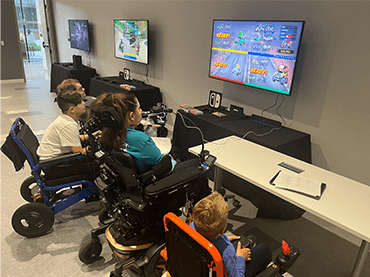
That experience also highlighted how inclusive gaming environments can be for people. Someone using an adaptive controller can play alongside someone using a standard controller without fundamentally altering the shared experience. Few recreational activities offer that kind of integration. Think about a sport like basketball, or hockey. Yes, you can play those games with adaptive means like wheelchairs and sleds with skates, and yes someone playing basketball in a wheelchair and someone who is not can play together, but it’s a different kind of playing together. Not so in a video game.
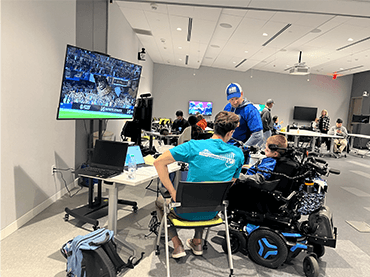
I think many clinicians still view gaming as solitary. How do you address that perception? It is understandable because gaming used to be more localized, but online platforms have changed how people interact. For many individuals, especially younger patients, gaming environments function as shared digital spaces where friendships are maintained and communication happens regularly. It’s exactly the same dynamic as if you were in a golf league, for example.
What makes gaming distinct is that individuals with and without disabilities can participate together in the same environment. A person using an adaptive controller does not need a separate version of the activity. They can join the same game session as their peers.
That continuity matters. It allows people to remain integrated within their existing social circles rather than shifting entirely to new or segregated activities after injury.
Q: Does adaptive gaming have applications beyond recreation?
A: Very much so. Many adaptive gaming interfaces can be configured for general computer use. Sip-and-puff systems can function as computer mice, while switch and joystick interfaces can allow cursor navigation and menu control.
I worked with one individual who used the same equipment for gaming and for completing college coursework. The motor skills developed during gameplay translated into broader digital independence, allowing him to participate academically without needing separate tools. This overlap becomes particularly important when considering funding. Equipment that supports educational or vocational activities may qualify for assistance through vocational rehabilitation programs or waiver-based funding. Demonstrating functional applications beyond recreation can make acquisition more feasible.
Q: How does motivation influence use of these technologies?
A: Learning adaptive interfaces takes time. Early attempts are often frustrating for people because individuals must develop new motor patterns and interaction strategies. Progress depends on repetition and patience.
When the technology supports activities that people genuinely care about, they are more willing to invest the effort needed to become proficient. Gaming frequently provides that motivation because it connects directly to enjoyment and social interaction.
In some rehabilitation settings, gaming can also support therapy sessions by maintaining engagement during repetitive exercises. The activity provides structure and purpose while patients practice movements that contribute to functional improvement.
Q: You developed an educational platform focused on adaptive gaming. What led you to create GamingReadapted.com?
A: One of the most consistent barriers I saw was lack of information. Patients and families often did not know what adaptative gaming technologies existed, how to obtain them, or how to configure them once they arrived. Even clinicians in rehabilitation settings frequently had limited exposure to adaptive gaming systems. It’s really a new field.
GamingReadapted.com grew out of that gap. The goal was to create a centralized, practical resource that explains what adaptive controllers are available, how they differ, and how they can be configured for individual needs.
The site includes structured overviews of major controller systems, guidance on selecting appropriate equipment, and step-by-step tutorials that walk users through setup and customization. I also developed demonstration videos that show how systems function in real-world scenarios, because seeing the technology in use makes it far easier to understand than reading technical descriptions.
The platform serves both individuals and clinicians. Patients and families can use it as an entry point to understand options and begin exploring solutions. Providers can use it as a reference to become more comfortable discussing adaptive gaming and supporting implementation.
The broader aim is to reduce informational barriers so interest in adaptive gaming is not limited by lack of accessible guidance.
Q: Where and how do you see adaptive gaming fitting into rehabilitation care and research in the future?
A: Adaptive gaming is still developing as a formal area within rehabilitation medicine, but interest continues to grow as more clinicians recognize its relevance to participation and social reintegration. Research is beginning to clarify both the barriers that limit access and the practical strategies that can expand it.
Early work has highlighted several consistent challenges, including equipment cost, limited clinician familiarity with adaptive systems, and lack of structured opportunities for individuals to trial devices before committing to them. At the same time, studies suggest that individuals who engage in shared gaming environments report stronger social connections and reduced isolation compared with those who participate alone. Medical insurance does not cover the cost of these devices for purely gaming use, but I think over time that will change as the evidence base builds.
Ongoing research is focused on identifying the most effective ways to integrate adaptive gaming into rehabilitation programs, developing structured assessment approaches, and expanding educational resources for both clinicians and patients. I’m working on some of these areas specifically in my own research.
As technology evolves, improvements in controller design and game-level accessibility features are expected to make participation possible for a broader range of individuals with physical limitations. I think video game designers and console manufacturers are also getting more on board, too, which is promising.