


Password Reset
Forgot your password? Enter the email address you used to create your account to initiate a password reset.


Forgot your password? Enter the email address you used to create your account to initiate a password reset.
18 Minutes
Transforming the Outpatient Landscape Through Practice Consolidation
In early 2024, UPMC Magee-Womens Hospital undertook a sweeping reorganization of its outpatient academic obstetrics and gynecology services, merging three distinct care arms into a unified, integrated practice known as University Ob-Gyn (UOG). The initiative — co-led by Jennifer Stofferahn, MD, and Erin Rhinehart, MD, but backed and supported by the entire academic department and hospital administration – sought to eliminate the inefficiencies and disparities of parallel systems by combining two faculty-led UPMC Magee and community practices and the UPMC Magee Outpatient Clinic, a resident-staffed clinic.
In doing so, UOG created a jointly managed, team-based care environment with shared staffing, streamlined workflows, and a renewed focus on continuity of patient care. Importantly, it established a model of outpatient ob-gyn care that offers equitable access for all patients, regardless of insurance status or background, while simultaneously enhancing resident education.
"This project reflects a fundamental shift in how we think about delivering outpatient ob-gyn care in an academic environment," says Dr. Stofferahn. "It is about meeting patients where they are, breaking down barriers, and creating a practice that embodies equity, efficiency, and excellence in medical education."
Prior to the merger, outpatient academic ob-gyn care was split between the so-called "residency clinics,” historically structured to care for underinsured or Medicaid patients, and the "faculty practice offices" that saw primarily privately insured patients. The two systems ran with separate nursing and administrative support, billing structures, and staffing protocols, but delivered the same general types of care and services.
"These were essentially parallel systems, and that was not unique to UPMC," says Dr. Rhinehart. "Academic ob-gyn programs across the country function this way. But the model was outdated. It reinforced inequities and created inefficiencies. We believed there was a better way. Patients deserved better integration and so did the people learning to become obstetrics and gynecology physicians."
A significant conceptual shift of the UOG model is its reframing of what outpatient care looks like. The term "clinic" has been phased out in favor of "office" to reinforce the redesign.
"'Clinic' has historically been associated with under-resourced, slow, and fragmented care," Dr. Stofferahn says. "That is not what we are doing. UOG is an office-based practice that delivers high-quality, equitable care for everyone."
The new model features a unified team of residents and attendings who share panels and care responsibilities. Every patient receives care in the same setting, regardless of payer mix. While Medicaid patients historically comprised the majority in the resident-run practice, UOG now ensures equitable distribution of patient types and services across all providers. This approach promotes fairness and enhances the overall quality and efficiency of care. Rather than equalizing by reducing access or experience, the UOG model is creating parity in standards for all patients, and brings together the best elements of continuity, patient flow, clinical education, and patient experience in a single, integrated system.
Under the old clinic structure, patients experienced wide variability in their ability to see the same provider over time. This is, in part, a natural consequence of the rotational nature of residency training, which requires residents to move frequently between services and sites. The new model addresses this challenge by structuring care teams around consistent faculty and advanced practice providers (APPs) who serve as longitudinal anchors for both patients and the office staff. This framework creates a more stable environment in which residents can build continuity with patients when their schedules allow, while ensuring that every patient receives consistent, team-based care even as resident assignments change.
"It was not uncommon for a patient to see a different resident at every visit," Dr. Rhinehart says. "Now, with shared schedules and faculty oversight, we are building true care teams."
This change is particularly impactful for a field like ob-gyn, where the patient-provider relationship often spans emotionally intense or complex situations, from infertility and miscarriage to pregnancy and delivery.
"Gynecology is a space of profound vulnerability," Dr. Stofferahn says. "Continuity and trust are not luxuries. They are at the core of delivering safe and compassionate care."
From an educational perspective, UOG enhances resident training in several ways. The new model allows residents to manage a panel of patients longitudinally, giving them real-world exposure to continuity of care, billing and coding, and the full spectrum of gynecologic and obstetric conditions.
"We are after more than our residents seeing a lot of patients,” Dr. Rhinehart says. "We want to ensure they are exposed to a large variety of cases, learning to manage workflows, and experiencing the day-to-day realities of ambulatory ob-gyn care."
The transition away from an isolated preceptor model to integrated faculty-resident teams has also enriched supervision and the feedback residents receive from attendings. Faculty now have more opportunities to observe resident decision-making and guide their development as clinicians in real time.
Beyond the structural consolidation, the UOG model introduced targeted innovations in specific areas of patient care. Acute visits, including those for miscarriage management, are now streamlined through a designated system allowing patients to be seen more rapidly.
"Historically, urgent visits were squeezed into overbooked schedules," Dr. Stofferahn says. "Now we have protected time and the staff to meet these needs promptly and respectfully."
The practice has also formalized the use of "social factors care plans," originally developed in the resident clinic. These plans help coordinate complex social needs across inpatient and outpatient settings that are related to transportation, housing insecurity, language barriers, behavioral health, or other nonmedical factors that can weigh heavily on patients when they need to access health care services.
"These are incredibly effective at improving the patient experience and their care coordination," Dr. Rhinehart says. "They are now being adopted hospital-wide."
Postpartum care has undergone major changes as well in the new UOG. Instead of separate resident and faculty rounding, a dedicated postpartum faculty rounder now ensures daily, consistent visits and better discharge coordination.
"We are getting people out of the hospital faster, safer, and more satisfied," Dr. Rhinehart says.
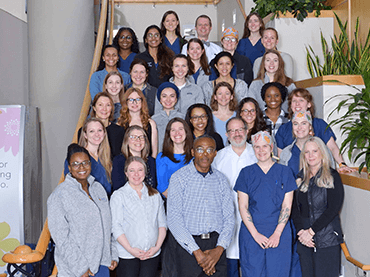
Caption: University Ob-Gyn Team
To give concrete and real-world perspectives on the resident ob-gyn training experience at UPMC Magee prior to, during, and after the implementation of UOG, below are perspectives from three clinicians who have completed their residency or are still actively training. Their experiences have helped to shape the new UOG and provide insights for the future.
Belita N. Opene, MD, MS, earned her medical degree from the Howard University College of Medicine and is currently a third-year ob-gyn resident (as of 2025). Dr. Opene also holds a master’s degree in biology from Adelphi University in New York. After residency, Dr. Opene plans on pursuing fellowship training in reproductive endocrinology and infertility. Dr. Opene has experienced both sides of resident training. She began her training under the old outpatient structure and now serves as the ambulatory chief resident training under the new integrated UOG model. Her experience in both worlds offers a dual perspective as a trainee adapting to the changes in the UOG model, and as a liaison contributing to its evolution.
"I was definitely skeptical at first because it was such a big change to go through right in the middle of residency, but the new UOG model has performed well. There is more structure, more continuity, and a better learning environment overall," says Dr. Opene.
For Dr. Opene, one of the most tangible improvements has been the greater clarity and organization of the new structure. Previously, color-coded clinic schedules often led to confusion about assignments and patient flow, with both staff and residents uncertain about where they were supposed to be. The new model assigns residents to consistent teams and supervising attendings, creating more predictability for everyone involved.
"There was a lot of overlap and ambiguity, and for residents, that created a stressful environment with little predictability. Now we know exactly where we’re supposed to be, and so do our patients," Dr. Opene says.
Another key enhancement is the structure of faculty supervision. Rather than several residents working with one attending, each resident now works more directly with a designated faculty member, which has improved real-time feedback and created a more personalized educational experience.
"It is not about being compared to a senior resident anymore. It is just you and the attending, working through cases together, choosing patients based on learning goals or other criteria. That peer-to-peer dynamic is a huge benefit," Dr. Opene says.
The acute care structure has also been redesigned. In the past, urgent follow-ups were channeled into a single, overburdened clinic often led by interns, which strained capacity and continuity. Under the new model, those visits are distributed across care teams, improving balance and reducing burnout.
"The workload is more balanced, interns are better supported, and the system is more responsive. It feels more manageable, and patients still get the timely and appropriate care they need," Dr. Opene says .
Longitudinal care has also improved. Stable teams enable residents to follow patients through multiple visits and pregnancy, creating a sense of familiarity and trust.
"Patients remember us, and they appreciate that we remember them. That continuity of care really matters, especially in ob-gyn care, where so much of the work we do is deeply personal," Dr. Opene says.
In the future, Dr. Opene sees value in possibly expanding structured avenues for resident input. As chief resident, she views this moment as an opportunity to strengthen the model further by incorporating resident perspectives in ongoing improvement efforts.
"We’re already seeing the benefits of the new structure, but I think ongoing resident input will help to make the model sustainable and successful," Dr. Opene says. "With the UOG transformation, we have a more stable, equitable, and educationally diverse program that translates into more optimal patient care and satisfaction.”
Lauren Sutherland, MD, is currently a first-year maternal fetal medicine (MFM) fellow at UPMC Magee, following her obstetrics and gynecology residency training, also at UPMC. After finishing her MFM fellowship, she will remain at UPMC to complete an additional one-year fellowship in perinatal addiction medicine, with a clinical and research focus on substance use disorder in pregnancy and postpartum care transitions. During her training, she has worked under the mentorship of Elizabeth Krans, MD, MS, whose research in maternal addiction care helped influence her decision to pursue residency and fellowship at UPMC.
During residency, Dr. Sutherland served as clinic chief resident during the early phases of the UOG merger. In that role, she participated in resident-level discussions about the transition and helped communicate changes to her co-residents as the new model was developed and introduced, providing resident perspective during the implementation process.
"We had the opportunity to really make changes, not simply do things because that’s how they had always been done," says Dr. Sutherland.
The old clinic model, while common across most, if not all ob-gyn academic training programs, posed challenges that extended beyond daily logistics. Residents largely managed their own clinics independently, often balancing heavy volumes with variable levels of faculty supervision depending on the day. Learning was heavily dependent on which attending physician happened to be staffing clinic, and educational experiences could fluctuate widely from one clinic session to the next.
"It was a lot of learning by doing. Some days you had excellent support, other days it was harder. There was no consistent rhythm to it," Dr. Sutherland says.
More importantly, the structure unintentionally reinforced longstanding disparities in how care was organized and delivered. Resident clinics disproportionately served patients with Medicaid, limited insurance coverage, or complex social needs, while faculty practices largely served privately insured patients. The separation of patient populations based on insurance status was visible not only in clinic, but also as patients transitioned to hospital-based or surgical care.
"Any system that segregates patients based on their insurance or ability to pay is not a fair system. We were very proud of the care we provided in the resident clinics, but it should not have been two separate systems," Dr. Sutherland says.
The merger created an opportunity to dismantle those divides. Under the new model, residents and faculty work in fully integrated teams, providing care to a unified patient population with improved continuity, regardless of payer status. Structural changes also extended to high-risk pregnancy care, with MFM clinics incorporated into the unified model.
"What we are doing is fundamentally about institutional change. Equitable care and high-quality education are not competing goals. They are linked," Dr. Sutherland says.
Now as an MFM fellow supervising residents in the integrated system, Dr. Sutherland sees firsthand how the redesigned model supports a more consistent and structured educational experience for trainees. Residents work in more stable teams with clearer expectations and additional opportunities for real-time feedback from attending faculty.
"There is more predictability in the learning environment, and that allows for better clinical growth and better patient care," Dr. Sutherland says.
While acknowledging that any clinical education model will continue to evolve, she views the UOG redesign as an important step in addressing structural inequities, strengthening resident education, and improving how care is delivered to patients
"There is no such thing as a perfect system, but the UOG merger was a chance to address something foundational. The fact that leadership at all levels was willing to have real conversations about equity and ethics in education and patient care is why this has worked," Dr. Sutherland says.
Sarah Smith, MD, earned her medical degree from the University of Cincinnati College of Medicine. She completed her ob-gyn residency at UPMC Magee at the end of June 2025 and is transitioning into private practice as an obstetrics and gynecology generalist in her hometown of Lexington, Kentucky. As a resident, Dr. Smith trained in both the legacy clinic system and the new UOG model. As such, Dr. Smith offers a longitudinal view of how the redesign changed care delivery, resident education, morale, and team culture. She also shares her perspective on how her residency training at UPMC Magee will carry forward and inform her medical practice as an independently-working ob-gyn generalist.
To level-set the discussion, Dr. Smith describes her residency training at UPMC Magee —before and after the merger – as highly-varied, rigorous, and of the highest-quality. She describes the old training system as one that fostered autonomy, clinical ownership, and adaptability in a high-volume environment. The new UOG model did not replace or dilute those strengths but instead added more structure and consistency that enhanced the training dynamic for residents but also the entire structure of patient care for faculty, students, staff, and patients.
“We had excellent training before the merger, let me just be clear about that,” says Dr. Smith. “I think what the UOG merger has done is add more support around that, more structure and more feedback without taking away resident autonomy or the exposure to the full breadth of clinical conditions and patient volume we have at UPMC Magee,” says Dr. Smith.
One of the most valuable aspects of the UOG transition according to Dr. Smith was the increased emphasis on longitudinal patient care and the continuity it enabled. With dedicated care teams and integrated schedules came the opportunity to care for patients across the full spectrum of outpatient and inpatient ob-gyn services.
“I saw patients through their entire pregnancy, and in some cases through delivery and postpartum. That kind of continuity was harder to achieve in the old system, and it helped me grow as a clinician,” says Dr. Smith.
The new UOG structure also provides residents more predictable faculty support, which has made a noticeable difference for Dr. Smith in her ability to make timely decisions and engage in complex conversations. Having attendings present throughout the day, not just precepting in isolated moments, created space for real-time mentorship and a more nuanced learning experience.
“It makes a big difference knowing someone is there to walk through a case with you in real time supporting you and helping you to learn how to think through a plan of care,” Dr. Smith says.
These changes built into the UOG model have had direct relevance for her future practice as an attending physician.
“UOG gave me the tools to function like a real outpatient ob-gyn in how to make decisions, coordinate care, and manage a full day of clinic while still being present for patients,” Dr. Smith says. “It brought more predictability to our days and made it easier to focus on what we’re there to do which is learn, care for patients, and develop as future ob-gyns.”
Dr. Smith also emphasizes the UOG model’s commitment to equitable patient care. By merging historically separate tracks for Medicaid and privately insured patients, UOG created a single system in which all patients receive care in the same space and structure.
“It matters that everyone walks through the same door,” Dr. Smith says. “It sends a message about what kind of practice you are, how you view and care for your patients, and what kind of physician you want to be.”
As Dr. Smith leaves UPMC Magee and transitions into her independent practice, she credits her experience in the UOG model, and the residency program as a whole at UPMC Magee, with giving her the skills, knowledge, and training to confidently step into her next role.
“I feel ready,” Dr. Smith says. “I know how to build relationships with patients, how to manage complexity, and how to navigate a health care system. That is what you need when you are out caring for patients as an attending.”
Despite merging operations, the UOG practice continues to occupy both its original spaces in the hospital. Plans are underway to renovate the resident clinic space to consolidate operations so that they reflect the new unified care model.
"We are functioning in two spaces right now because this merger needed to get started, but we are looking forward to construction and building a single defined space that reflects who we are now, which is a practice where everyone receives the same high-quality care,” Dr. Stofferahn says. “We need the physical space to match the excellent care being provided by our team."
The renovation will address not only aesthetics, but also patient flow, privacy, and navigation, all factors that can influence one’s trust and the perception of the care received.
Evaluating the success of the merger will require time and multiple measures. On the clinical side, UOG is examining traditional obstetric indicators (e.g., hemorrhage rates, infection rates, prenatal hemoglobin levels) and assessing changes in access to desired services, including long-acting reversible contraception (LARC).
"Our north star is improving community health outcomes," Dr. Stofferahn says. "But those changes take time. So, in the immediate period, we are also tracking surrogate measures like patient satisfaction, appointment wait times, and doula access, which themselves are important but meaningful proxies for bigger questions we’ll be able to answer in the future once enough data accumulates.”
The educational side of UOG also is being rigorously assessed. A pre-post study tracks resident exposure to core complaints and procedural volumes, while billing instruction has become a structured part of all resident training. Faculty and residents are collaborating on research and quality improvement efforts tied to the merger, as well.
"Already, we see more breadth in what residents are learning in the office," Dr. Rhinehart says. "They are managing more complex cases and developing the skills they will need in real-world practice."
Longer-term, the UOG model is positioned to serve as a national example of how integrated, equity-driven academic ob-gyn care can be structured and succeed. The team is exploring opportunities for collaboration and dissemination through academic conferences and publications.
"We know others are watching us to see if this can be replicated," Dr. Stofferahn says. "And the early signals are promising. We have not compromised education or care. We have elevated both."
Institutional support has been critical to the project’s success.
"This was not something Erin and I could have done alone," Dr. Stofferahn says. "Our office staff, our residents, our colleagues, and our leadership made this happen. It reflects who we want to be as a hospital and a community."
For both Drs Rhinehart and Stofferahn, the UOG merger was as much about ideals as operations.
"This is about building the practice we would want to go to ourselves," Dr. Rhinehart says. "The kind of practice where everyone is seen, heard, and valued. Where the care is excellent, and the experience is dignified. That is what we are working toward."
As the UOG model matures, the team plans to collect further data on patient outcomes and educational quality, as well as continuing focus groups to refine operations. Interviews with resident physicians who trained under both the old and new systems are also planned to provide an additional perspective on the impact and evolution of the UOG model.
"There is still more to learn and improve upon," Dr. Rhinehart says. "But we believe this is the right foundation for the future of our students and patients. Now we just have to keep building and refining the program for durable success."

