

Password Reset
Forgot your password? Enter the email address you used to create your account to initiate a password reset.


Forgot your password? Enter the email address you used to create your account to initiate a password reset.
6 Minutes
The Heart Institute at UPMC Children’s Hospital of Pittsburgh has recently implanted extravascular implantable cardioverter defibrillators (EV-ICDs) in its first two pediatric patients. The procedures, completed on the same day in a multidisciplinary collaboration with members of the UPMC Heart and Vascular Institute, are the Institute’s initial clinical experience with this technology in children and reflects an effort to address limitations of traditional ICD systems in smaller and more active pediatric patients.
The EV-ICD system currently in use and developed by Medtronic® was approved for adult patients in 2023. Its use in pediatric patients is now being studied, with early clinical experience informed by prior adult implantations.
The Heart Institute at UPMC Children’s is part of a limited number of pediatric centers in the United States currently able to implant EV-ICDs in children.
While ICD therapy is well established in adult electrophysiology, its application in pediatric patients has been at times limited by patient anatomy, growth considerations, and the invasiveness of available implantation strategies. In children who are too small for transvenous systems, clinicians have historically had to choose between delaying implantation or pursuing epicardial placement through a much more invasive, open thoracic procedure. Both options carry procedural risks and clinical benefit tradeoffs.
The EV-ICD system changes the clinical dynamic by allowing clinicians to provide defibrillator protection without transvenous access or an invasive open surgical procedure.
 “What this offers is a way to provide ICD protection without having to open the chest,” says Christopher Follansbee, MD, assistant professor of pediatrics and member of the Heart Institute’s electrophysiology program who helped to lead the first EV-ICD cases alongside colleagues from pediatric cardiothoracic surgery and adult cardiology and electrophysiology. “Compared to epicardial systems, it is a much less invasive approach and significantly reduces procedural morbidity for patients who otherwise had limited options.”
In adult patients, ICDs are most often implanted using a transvenous approach, with leads advanced through the venous system into the heart with the generator placed near the shoulder. In pediatric patients, however, this pathway is frequently suboptimal because of anatomic factors.
“For many of our patients, their blood vessels just are not big enough because these systems were designed for adults,” Dr. Follansbee says.
When transvenous placement is not possible in children, clinicians have relied on alternative approaches. Subcutaneous systems may still be too large for smaller children, while epicardial ICDs require open surgery to place device leads on the surface of the heart.
The EV-ICD system avoids both transvenous lead placement and open-chest surgery. The device lead is placed through a small incision below the sternum and tunneled behind the breastbone, where it can deliver defibrillation therapy and pacing when needed. This substernal positioning allows clinicians to provide ICD protection while avoiding the morbidity associated with epicardial systems. From a clinical standpoint, the benefit is less about the device functionality itself than about how it alters procedural risk and timing, and how it potentially increases the number of patients that can benefit from this life-saving technology.
“For patients who previously would have required epicardial placement, the EV-ICD gives us a way to offer arrythmia protection with substantially less surgical burden,” Dr. Follansbee says. “That difference matters when you are deciding whether to move forward now or wait, particularly in smaller patients.”
In pediatric electrophysiology, device durability and activity restrictions are not secondary considerations. Children and adolescents are typically far more active than adult ICD recipients, and transvenous systems are subject to repeated mechanical stress from arm movement.
“The activity level of children often is a limiting factor with traditional ICD devices,” Dr. Follansbee says.
Because the EV-ICD lead does not involve the shoulder or arm, mechanical stresses are potentially reduced.
“This gives us the ability to remove restrictions on arm usage while still providing arrythmia protection,” Dr. Follansbee says. “It can help our patients feel safer as they get back to their typical daily activities and lifestyle.”
In its early use at the Heart Institute at UPMC Children’s, EV-ICD implantation is being considered for specific pediatric populations in which the balance of risk and benefit is favorable.
One group includes children with cardiomyopathies, including hypertrophic or dilated cardiomyopathy, in whom progression of myocardial disease increases their susceptibility to malignant arrhythmias.
“As the heart muscle becomes thicker or weaker, patients become more susceptible to dangerous arrhythmias,” Dr. Follansbee says.
For some of these patients, heart transplantation may ultimately be required, but earlier arrhythmia protection can extend the time before a transplant becomes necessary, because the transplant itself is time-limited.
A second group includes patients who experience sudden cardiac arrest due to arrythmia of idiopathic origin, a clinical scenario that often involves young athletes who develop dangerous or life threatening ventricular arrythmias without warning. In these cases, the goal is to establish protection while supporting a return to normal activity.
“These are the patients you hear about who have an arrest episode and we cannot identify a clear reason,” Dr. Follansbee says. “As long as we can get protection in place, the goal is to get them back to full activity participation safely.”
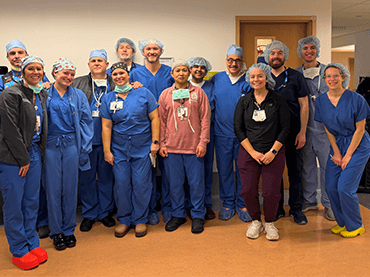
The first two EV-ICD implants at UPMC Children’s involved a patient with Becker muscular dystrophy and a patient with hypertrophic cardiomyopathy. Both procedures were performed on the same day and relied on close collaboration between the pediatric and adult cardiology and cardiothoracic surgery teams at the Heart Institute and the UPMC Heart and Vascular Institute.
“This was very much a collaborative effort between our pediatric team and our adult cardiology and surgery colleagues who have extensive experience with the EV-ICD device in adult patients,” Dr. Follansbee says.
Adult electrophysiologists from the UPMC Heart and Vascular Institute played a central role in these first pediatric cases. Alaa A. Shalaby, MD, professor of medicine and director, Ventricular Tachycardia (VT) Program, has extensive experience in adult EV-ICD implantation and collaborated on the pediatric cases.
“Dr. Shalaby has worked on more of these cases than anyone else within UPMC on the adult side,” Dr. Follansbee says.
Cardiothoracic surgical support was provided by pediatric cardiothoracic surgeons Mario Castro Medina, MD, and Richard Tang, MD, who will serve as surgical partners moving forward. Timothy C. Wong, MD, MS, director of the UPMC Hypertrophic Cardiomyopathy Center and associate director of the UPMC Cardiovascular Magnetic Resonance Center, supported imaging review and candidacy assessment.
“Dr. Wong helped the team review imaging and determine whether our patients were good candidates for the EV-ICD based on body habitus,” Dr. Follansbee says. “This kind of collaboration and experience between pediatric and adult cardiology and cardiac surgery is a benefit for our patients.”
 At the Heart Institute at UPMC Children’s, early adoption of EV-ICDs reflects a coordinated effort to adapt adult electrophysiology advances safely and effectively into pediatric care, with ongoing evaluation of outcomes, durability, and long-term implications as the team’s clinical experience increases.

