


Password Reset
Forgot your password? Enter the email address you used to create your account to initiate a password reset.


Forgot your password? Enter the email address you used to create your account to initiate a password reset.
3 Minutes
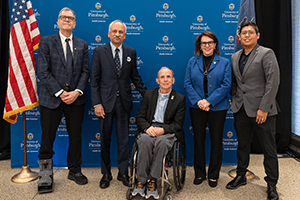 Researchers at the Human Engineering Research Laboratories (HERL) have been awarded a grant of up to $41.5 million from the Advanced Research Projects Agency for Health (ARPA-H). The funding will support the development of the Robotic Assisted Mobility and Manipulation Platform (RAMMP), a next-generation system designed to dramatically enhance independence, safety and quality of life for individuals with disabilities, including veterans.
The RAMMP initiative aims to reimagine the traditional wheelchair and reduce reliance on caretakers. With plans to be developed over five years, RAMMP will integrate advanced robotics, artificial intelligence, a novel open-source assistive technology operating system and digital twin technology to create a smarter, safer and more functional mobility solution.
The project’s co-principal investigators are Rory Cooper, director of HERL, and Jorge Candiotti, research biomedical engineer within HERL and the U.S. Department of Veterans Affairs.
“Most powered wheelchairs aren’t designed to overcome many of the common challenges in the real world — and changing the environment to accommodate them is nearly impossible,” Cooper says. “We need smarter technology that prevents tipping and falling, improves mobility and adds more function such as coordinated mobility and robotic arm manipulation of objects so people with disabilities can fully participate in everyday life.”
The RAMMP grant is the first ARPA-H with HERL and the University of Pittsburgh as the lead institution. The recognition builds on HERL’s pioneering work, including the development of the Mobility Enhancement Robotic Wheelchair (MEBot), which can autonomously climb curbs and stairs while maintaining a stable seat.
Each year, more than 100,000 wheelchair-related injuries are treated in emergency departments in the United States, often due to tipping and falling. RAMMP seeks to prevent those with an approach that actively involves wheelchair users, clinicians and advocacy groups in codesigning solutions tailored to real-world needs.
The project brings together a national consortium of partners, including Kinova Robotics, LUCI Mobility, ATDev, Carnegie Mellon University, Cornell University, Northeastern University, Purdue University and Indiana University.
RAMMP promises not only to redefine assistive mobility but also to serve as a catalyst for broader advances in rehabilitation and robotics. With its emphasis on user-centered design and cutting-edge technology, RAMMP is poised to become a beacon of innovation — empowering individuals with disabilities and reshaping the future of mobility.
“Our goal, really, is to show what can be done so we change everybody's human world.”
Learn more about HERL and its efforts.

