

Password Reset
Forgot your password? Enter the email address you used to create your account to initiate a password reset.


Forgot your password? Enter the email address you used to create your account to initiate a password reset.
13 Minutes
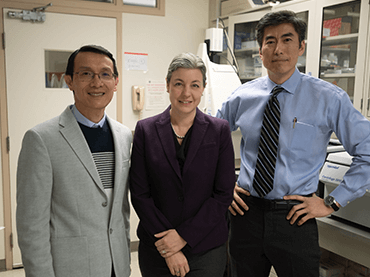 Codirectors of the Ferguson Laboratory for Orthopaedic and Spine Research, Gwendolyn A. Sowa, MD, PhD, professor and chair of the Department of Physical Medicine and Rehabilitation at the University of Pittsburgh School of Medicine, and Nam Vo, PhD, professor of orthopaedic surgery and deputy vice chair of research in the Department of Orthopaedic Surgery at Pitt, have received a five-year, $20 million National Institutes of Health (NIH)/National Institute of Arthritis and Musculoskeletal and Skin Diseases (NIAMS) award to continue and expand a multidisciplinary investigation into the phenotype evolution and clinical trajectories of chronic low back pain (CLBP).
The award supports the next phase of the original Low Back Pain Biological, Biomechanical, and Behavioral (LB3P) study, now called the Holistic Pain Phenotypes (H2P) LB3P study, building on work originally funded in 2020 through the NIH Helping to End Addiction Long-Term (HEAL) Initiative–funded Back Pain Consortium (BACPAC). The renewed study brings together the prior multidisciplinary team from orthopaedics, rehabilitation, bioengineering, pain medicine, psychology, molecular biology, biostatistics, and related fields, along with a strategic group of new researchers to examine CLBP as part of a broader whole-person pain experience.
“The first phase of LB3P focused on building the data foundation needed to understand how pain manifests across multiple domains and to determine whether distinct pain phenotypes exist,” Dr. Sowa says. “This next phase allows us to ask how those features relate to what actually happens to patients over time.”
CLBP remains one of the most common and costly causes of disability. Patients with similar clinical presentations often experience very different outcomes when treated with the same interventions. Some improve, others remain stable, and others worsen, despite receiving similar types of care or treatments.
This variability reflects the heterogeneity in the biological, biomechanical, and behavioral factors that contribute to CLBP, which are not captured by traditional symptom-based classifications or imaging findings alone.
The original LB3P project was designed to address this problem directly. Rather than testing specific treatments, the study developed a comprehensively characterized cohort to examine how multiple domains (biological, biomechanical, and behavioral characteristics) interact within the same individuals and whether those interactions define distinct phenotypes of CLBP.
“The goal was not to prove that one factor matters more than another,” Dr. Vo says. “It was to collect the data needed to ask better questions about how and why patients with CLBP differ in the first place.”
The initial LB3P grant enrolled more than 1,000 participants with CLBP and followed them for one year. Data were collected from individuals without low back pain to provide a comparative control cohort for analysis
The LB3P study has collected a broad range of data capturing pain-related processes across domains, including clinical assessments, biomechanical and movement analyses, quantitative sensory testing, psychosocial and behavioral evaluations, and biospecimen collection for molecular and omics analyses.
Including control individuals without low back pain strengthens interpretation of the dataset by providing context for biological and biomechanical signals observed in the chronic pain cohort. This comparative framework is helping the study teams distinguish features specific to CLBP from those of general pain susceptibility, functional limitation, or aging-related changes.
“What LB3P gave us was the ability to study low back pain as a system rather than as isolated variables,” Dr. Vo says. “By collecting these data in the same patients, we can begin to see which combinations of factors are associated with different experiences of pain and disability.”
To date, the LB3P research team has published multiple peer-reviewed papers (see below) examining individual components of the dataset, including biological markers, biomechanical measures, behavioral characteristics, and sensory processing. These studies have provided initial insight into how specific domains relate to CLPB pain and function.
More recently, the analytic efforts have focused on integrative analyses to determine whether patients cluster into phenotypes.
“Our early analyses suggest that there are patient subgroups that differ in meaningful ways,” Dr. Sowa says. “For example, we see groups with similar reports of pain that tend to have different levels of function, movement patterns, or different medical comorbidities, as well as different biological profiles. These findings are preliminary and do not yet incorporate the entirety of the available data, but they suggest that distinct phenotypes may be present.”
Although the early analyses suggest candidate phenotypes, the initial LB3P project was not designed to determine how those phenotypes may evolve over time or how they are shaped by the presence of other chronic pain conditions. It is still unknown if phenotypic features represent stable characteristics, transitional states, or responses to changing biological and behavioral factors. Understanding these aspects of CLBP is the primary focus of the newly awarded grant.
The new grant extends the original LB3P project by allowing the team to follow the study’s cohort for up to five years. This longitudinal examination will provide data on how early phenotypic features relate to longer-term clinical trajectories, including improvement, persistence, or progression of pain and disability.
“What we want to understand now is what happens to these patients over time,” Dr. Vo says. “Do they get better, stay the same, or worsen, and which characteristics or biomarkers are associated with those paths.”
The longitudinal design of the new study also allows Dr. Vo, Dr. Sowa, and colleagues to examine how patient-specific features may change alongside their clinical outcomes. Rather than assuming the phenotypes identified at baseline remain fixed, the study will evaluate whether phenotypic profiles evolve as pain improves or persists and whether those changes are meaningful for prognostication.
An important part of the new study is designed to understand how CLBP phenotypes relate to other chronic overlapping pain conditions and common musculoskeletal disorders. These conditions often coexist with low back pain and can substantially influence symptom severity, disability, and treatment outcomes.
Without accounting for overlapping pain conditions, it is difficult to determine whether observed phenotypic features are specific to low back pain or reflect broader pain processing mechanisms.
“What became clear is that low back pain does not occur in isolation for many patients,” Dr. Sowa says. “If we ignore other pain sites, we risk misinterpreting what we are seeing in the data.”
The study continues to involve many investigators who contributed to the original project, while adding new collaborators to address scientific gaps identified during the first funding period. The new investigators are:
Ajay D. Wassan, MD, who leads an NIH HEAL–funded study focused on myofascial pain, is now more deeply engaged in the project to support interpretation of widespread and nonregion-specific pain patterns that may influence low back pain trajectories.
To address co-occurring craniofacial pain, the team has added Alex Almarza, PhD, from the University of Pittsburgh School of Dental Medicine. Dr. Almarza is an investigator in the NIH HEAL–funded RE-JOIN consortium and leads temporomandibular joint assessments within the study.
“These additions allow us to ask whether features we observe in low back pain reflect spine-specific mechanisms or broader pain processes,” Dr. Vo says.
At the mechanistic level, Michael Gold, PhD, from the Department of Neurobiology, and Hang Lin, PhD, from the Department of Orthopaedic Surgery, both investigators on NIH HEAL–funded projects, are contributing expertise in interactions between musculoskeletal and nerve cells that may underlie pain persistence across tissue types.
The project also has expanded its collaboration with the Department of Biostatistics. George Tseng, PhD, and Rebecca Deek, PhD, bring expertise in multi-omics, machine learning and high-dimensional data analysis.
“These analytic approaches are essential once you start working with the level of data complexity we have and will continue to collect from our study participants” Dr. Sowa says.
Using longitudinal outcome data and refined phenotypic profiles, the research team plans to design a clinical trial to test whether treatments can be matched to patient subgroups defined by underlying contributors.
“What this study will allow us to do in the future is design a clinical trial that is informed by the data we have generated, rather than assumptions,” Dr. Sowa says. “The goal is to determine whether patients who share certain characteristics respond differently to specific interventions, and whether matching treatments to those characteristics actually improves outcomes.”
This approach is part of a deliberate progression from data generation to hypothesis testing and eventual translation into efficacious therapy in the clinic, ensuring that future trials are grounded in a clear understanding of patient heterogeneity rather than treating CLBP as a single entity.
The continuation of the LB3P study will remain a major data resource for the Ferguson Laboratory. The dataset has the ability to support secondary analyses, methodological innovation, and trainee-driven research, with longitudinal follow-up expected to generate new scientific questions over time.
“Following patients over time allows us to see which early characteristics actually matter for outcomes,” Dr. Vo says. “That is information we simply could not obtain without this kind of sustained investment.”
Whole Person Experience of Pain: Novel Integration With Low Back Pain Phenotypes. Project Number1UC2AR086243.

